The Great Scott – Stuart That Is

Stuart Scott 010515

As a sports fan for life I have ridden the roller-coaster of emotions when cheering for my teams. The highs and the lows. But through it all there was the constant of Sports Center. The highlights. How many times did I watch Sports Center even though I already had seen the exact same show and the exact same highlights already? Over time the, sportscasters became as big as the event they were reporting. The first significant sportscaster who I use to quote all the time was Howard Cosell. Who can forget “Miami has the Oranges but Buffalo has the Juice!”  Then of course Chris Berman brought immediate attention to ESPN with his unique nickname style…nicknames like Mike “Your in Good Hands With” Alstott;  Jeff “Brown Paper” Bagwell and my personal favorite Joseph “Live and Let” Addai.

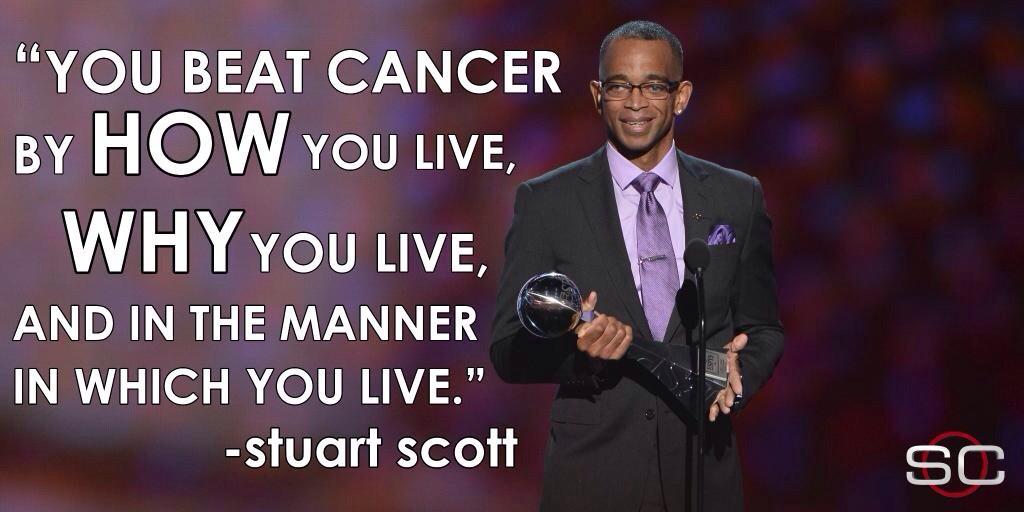
But then there was the best of them all, Stuart Scott. Stuart Scott showed us that sportscasters could be fun and the energy he displayed every time he appeared on camera will never be forgotten. Stuart Scott passed away yesterday after a long courageous fight against cancer. His swag as a reporter will forever be unmatched and he will be sorely missed. One thing is for certain, however, and that’s that his slogans and insightful quotes will always live on. Here are a few of my favorite Stuart Scott catch phrases:

If you were on fire on the basketball court –

Call him car wash because he is automatic

When referring to someone playing at a high level and with ease-

As cool as the other side of the pillow.

When a player was getting more rebounds than anyone else on the court-

They call him the Windex Man cause he’s always cleaning the glass.

When someone would begin to dominate a game-

Just call him butter ’cause he’s on a roll.

When someone would make a smart play-

Like gravy on a biscuit, it’s all good!

When someone would get ejected from a game-

You ain’t got to go home, but you got to get the heck up outta here.

When Bryce Harper hit a homerun-

And the Lord said you’ve got to rise up!

When a player torches another player-

He must be the bus driver cause he is takin’ him to school

If a pitcher got bombed for a home run-

Check if your bleeding cause you just got tagged

And finally – on the only way to fight cancer-

So live. Live. Fight like hell. And when you get too tired to fight, lay down and rest and let somebody else fight for you.

The Great Stuart Scott- Rest in Peace – your words will live on.


Posted in Bersonal Posts | 1 Comment

Start The Year With S.W.O.T.

As partners, we share many of the same visions – some basic, some complex, some high and some low on the priority chart. But most of us share the same, fundamental goals: Produce more revenues, recruit more agents/advisors, find more clients, hire talented personnel, differentiate ourselves from competition, provide the best service, adopt the latest technologies, etc.

You don’t know what you don’t know is a popular phrase, but one that it’s best to not be satisfied with when running a company. About your business, there IS a way to find out what you don’t know.

At ISN we didn’t invent the SWOT analysis but have first-hand knowledge as to its benefits. Definition: An executive analysis of a company’s “Strengths, Weaknesses, Opportunities, and Threats.” Management at ISN Network conducts this analysis yearly in January in the form of a focused retreat off site. There is no designated day of the year in which it should be conducted. Formal or informal, off-site or on-site, some businesses conduct a SWOT annually and others bi-annually to bulletproof themselves from industry changes that come at warp speed and that can be devastating if unaddressed. Like so many insurance agents without a life policy of their own, attorneys without an estate plan, and doctors who avoid yearly examinations, surprisingly, there are business owners that are too closely involved with the day-to-day operations to see a need for inventory on their own business.

The benefits that come from examining such basic categories of your business are priceless. Delving into detailed discussions to outline the condition of your operations can be both inspiring and painful. But the generation of new ideas gleaned from this cost-free endeavor are one of many reasons why every company should partake in it. Bring your company’s talent together in an all-day setting to find that undiscovered pearl. You will find together different ways to not only view your business, but other ways to shape and grow it. Remember, any ideas and revelations that come alive within the SWOT process, it is paramount to bring those discoveries into a phase of initiatives to be carried out.

Posted in Bersonal Posts | Leave a comment

What is Your Philosophy for 2015?

As the year 2014 comes to an end, many of us tend to look back on the year and think about the things we did well and the things that did not go so well. Many times we think to address this by making “resolutions” that the next year will be different. Unfortunately, our New Years Resolutions tend to last about as long as it took for us to make them…in other words we fall back to old habits even though our best intentions are to change.

This year maybe we can go a step further. Instead of making a resolution to change, lets take a look at our philosophy. This is a fundamental way to look at how we live and work. A motto so to speak.

With that in mind I just finished reading Michael Soupios and Panos Mourdoukoutas book The Ten Golden Rules of Leadership.  InThe Ten Golden Rules of Leadership they have reviewed the writings of the Classical philosophers and selected ten ideas that will positively impact our leadership effectiveness. Not surprisingly, the philosophies of classic figures remain relevant in today’s workplace.

Genuine leadership is not complex but it is difficult because it requires that we do the inner-work on a continual basis. And that is a lot to commit to. It’s lifelong. And what we want to do is to check it off and mark it as good enough. Sustainable leadership requires a radical life-long commitment to rule one of leadership: Know Thyself. Here is the list of ten for you to ponder on…and maybe for 2015 a change in your philosophy can lead to success. Happy New Year.

Rule 1: “Know Thyself.” –Thales
This is an intimidating task and one that many never really get around to. It never seems as important as the task at hand. The larger issue though is that we all possess a “powerful tendency to obscure, distort, and fictionalize on behalf of a fabricated reality.” The authors note that “Knowing Thyself means bringing a fresh transparency to our hidden motives and identities.” They suggest that a would-be leader commit to “an agenda of spirited self-indictment.”

Rule 2: “Office Shows the Person.” –Pittacus
Giving a person power reveals their inner qualities. “Specifically, power discloses whether or not a person has disposed f the psychological deficiencies that negate the possibility of real leadership.”

Rule 3: “Nurture Community at the Workplace.” –Plato
Plato insisted that “there is no greater evil than discord and faction and no greater good than the bonds of communal sentiment.” The idea that if one part of the body suffers, we all suffer. “Foster a culture of cooperation and collaboration by defying the myth of the exceptional individual, and by explaining the corporate gains of working together.”

Rule 4: “Do Not Waste Energy on Things You Cannot Change.” –Aristophanes
The Athenian playwright Aristophanes wrote in his play titled Peace, “Never will you make the crab to walk straight.” Some things we cannot change. “Leaders must assume a posture of flexible response.”

Rule 5: “Always Embrace the Truth.” –Antisthenes
Antisthenes wrote, “There are only two people who will tell you the truth about yourself—an enemy who has lost his temper and a friend who loves you dearly.” “Honest assessment is an essential requirement of effective leadership.” The problem is that the higher up the ladder you go, the less likely you will receive complete and accurate information.” Seek the truth. Hire a heretic.

Rule 6: “Let Competition Reveal Talent.” –Hesiod
Hesiod suggested that competition that releases selfishness is destructive, but competition that releases ingenuity and creative is a constructive use of competition. Strife than is not the byproduct, but inner excellence and personal development.

Rule 7: “Live Life by a Higher Code.” –Aristotle
Aristotle wrote of the “magnanimous man” or the “great-souled” person. He is referring to a person that lives by a higher or more rigorous code than the average person. But not in a vain way. “When it comes to the great-souled individual, personal honor, not ego, is the ultimate priority and concern.”

Rule 8: “Always Evaluate Information with a Critical Eye.” –The Skeptics
“Leaders should never assume that the information they receive is unsoiled by hidden agendas or political agendas.” The problem though is even more personal than that. Socrates reminded us that “we must be vigilant against the conceits of wisdom [and] that we are all strongly inclined to assume we understand things that in truth we fail to genuinely comprehend.”

Rule 9: “Never Underestimate the Power of Personal Integrity.” –Sophocles
In the play Philoctetes by Sophocles, one of the two central characters believes that the ends justify the means; “one should not allow moral concerns to impede the necessities of practical achievement.” In the face of this seductive idea, the other main character, Neoptolemus, responds, “I would prefer even to fail with honor than win by cheating.” It’s easy to rationalize wrong behavior.

Rule 10: “Character Is Destiny.” –Heraclitus
Our character or our moral essence determines the course of our lives. While we can’t control the world around us, “Heraclitus was correct to insist that we are, to a very great extent, the authors of both our own blessings and our own burdens.” “A well formed character,” write the authors, “is the priceless reward paid to those who have done the hard work of coming to know themselves.”

Posted in Bersonal Posts | 2 Comments

Deal Reached – Pension Plans to Cut Benefits

In news out of Washington we hear another sad story about how the Pension Plans of the past, the time trusted institution of our fathers and grandfathers, are not working. This type of news is the perfect  example of why our clients need to think outside the box and plan for their own retirement.

The Washington Post – December 10, 2014

 A bipartisan group of congressional leaders reached a deal Tuesday evening that would for the first time allow the benefits of current retirees to be severely cut, part of an effort to save some of the nation’s most distressed pension plans. The measure, attached to a massive $1.01 trillion spending bill, would alter 40 years of federal law and could affect millions of workers, many of them partof a shrinking corps of middle-income employees in businesses such as trucking, construction and supermarkets.

“We have to do something to allow these plans to make the corrections and adjustments they need to keep these plans viable,” said Rep. George Miller (D-Calif.), who along with Rep. John Kline (R-Minn.) led efforts to hammer out a deal.

The idea is reluctantly supported by some unions and retirement fund managers who see it as the only way to salvage pensions in plans that are in imminent danger of running out of money. But it also has stirred strong opposition from retirees who could face deep pension cuts and from advocates eager to keep retiree pensions sacrosanct, even in cases when funds are in a deep financial hole. The advocates argue that allowing cuts to plans would open the door to trims for other retirees later.

“We thought our pension was secure,” said Whitlow Wyatt, a retired trucker who lives in Washington Court House, a small city in central Ohio. “That was always the word. Now they are changing that.”

Wyatt, 70, retired with a $3,300-a-month pension in 2000 after working more than 33 years as a long-haul driver. He could face pension reductions of 30 percent or more if Congress permits trustees of the hard-pressed pension fund to slash benefits. The deal is aimed at helping plans such as the Teamsters’ Central States fund. The pensions earned by truckers in the fund are among the best enjoyed by working-class people anywhere: After 30 years on the road, many of its participants are entitled to upward of $3,000 a month for the rest of their lives. But now the fund, rocked by steep membership declines, an aging workforce and downturns in the stock market, is in dire financial straits, putting the retirement benefits of 400,000 participants in jeopardy. The deal reached would apply to multi-employer pensions, where a group of businesses in the same industry join forces with unions to provide pension coverage for employees. The plans cover some 10 million U.S. workers.

“The longer we wait to take action, the more severe the impact on retirees and workers in the plans in the worst financial shape will become,” business leaders wrote. “The longer we wait, the heavier the burden will become on employers struggling to fund and extend these pension plans.”

That is the situation confronting the Central States plan, which was notorious in the 1960s and ’70s for being used as a slush fund for organized crime. Since then it has operated under federal court supervision and with the help of professional fund managers. Yet that has not been enough to overcome demographic and other trends that have weakened its finances.

Some see cutting benefits preemptively as the only way to keep troubled plans such as Central States afloat. Under the agreement reached by congressional negotiators, retirees over age 75 as well as those who are disabled would be shielded from any reductions. Also, any benefit cuts would be subject to a vote of plan participants. Nonetheless, many retirees feel betrayed. “I never dreamed they would pull the rug out from under us,” said Greg Smith, 66, a retired shipping clerk who retired in 2011 with a $3,000-a-month pension after 42 years on the job. “I actually retired because I was worried about them cutting pensions. I thought I would be grandfathered in with protections. But I guess not.”


Posted in Bersonal Posts | Leave a comment

Tips from a Little Leaguer

The world of sports has often been used to help us as financial professionals. In an earlier blog post I mentioned Brian Gilder’s book “The Financial Playbook” and how our top rep used sports to help simplify complex concepts. Now we again have a great example of how sports can help us be better…but this time it is from a 13-year-old girl.

The baseball world was abuzz this summer about a new phenom, 13-year-old female Mo’Ne Davis, who pitched a shutout in August during the first round of the Little League World Series. Working together, the Taney Dragons from Philadelphia didn’t make a single defensive mistake against strong opponents from Tennessee. Still, Davis’ two-hit, complete-game shutout was real pitching, not just fireball throwing.

Davis “ran a clinic,” as they say, on baffling hitters. The speed of her four-seam fastball reached 70 mph but she mixed it with a split-change and occasional curve, changing eye-level and speeds to keep Nashville off-balance. She had pitched an earlier shutout to propel her team into the series.

In an interview with ESPN, Davis acknowledged that she had studied the home plate umpire’s high strike zone and worked toward it, and that she was aware of her pitch count (57) going into the bottom of the sixth. She knew her limit of 65 was approaching if she was to be used again on three days’ rest, per Little League rules.

“So,” she said, “I knew I had to squeeze those eight pitches in and I was able to do it.”

Amazing insight from a 13-year-old. Be prepared by doing your research prior to the game. This translates well into our world.

— Adapted from “Mo’Ne Davis’ 2-hit shutout and Taney’s 4-0 win over big-hitting Tennessee club a joy to watch,” David Jones, PennLive.

Posted in Bersonal Posts | Leave a comment

Revisiting Sandy Hook – Throwback Thursday

handpainting

December 14, 2012. It’s been nearly two years since a disturbed young man, Adam Lanza, opened fire at the Sandy Hook Elementary School in Newtown, Conn., killing 20 young children and six adults. With that in mind I wanted to repost the tribute we posted when the tragedy happened. In the 2 years since the tragedy, the people of Sandy Hook have been working hard to bring awareness to a problem that needs to be addressed. You can read more about the mission at  their website. Please “pay it forward” as we try to get the message of  “A New Promise” to as many people as possible. Let us never forget what happened in Sandy Hook so we can prevent it from happening again.

Here on “Throwback Thursday” is my post inspired by the events at Sandy Hook.

Yes…I know…this is a Blog for insurance professionals so what is the tribute idea? Well I did say this would get “Bersonal” and for me the events that took place in Newtown, CT were very personal. The events at Sandy Hook were earth shattering to say the least. I have two children ages 7 & 4 and since I am originally from CT I was overwhelmed with grief as the news of what happened there hit me. I read everything I could get my hands on. I was determined to do something, to find some way to help. I found the Sandy Hook Promise website and I was inspired. I decided to take action.  I collaborated on this song with my friend Jayson. He does the singing and the music while I provided the words.  My brother Evan  added the photos and images and a tribute was born. Here is the latest version of our tribute to Sandy Hook….inspired by the website set up for the Promise of Sandy Hook.

Please, if you are so inspired…post it on your site…we plan to send this too as many people as possible to help support their cause.

A New Promise- A Tribute to Sandy Hook


Posted in Bersonal Posts | 1 Comment

An Offer You Can’t Refuse

Negotiation. The outcome of a negotiation can often be determined within the first five minutes of a meeting. Now if you are Vito Corleone, sometimes you have leverage that makes the outcome inevitable. For the rest of us, the art of negotiation is a skill that can be honed and fine tuned. Here are a few ideas to help you in this process.

  1. Share your most effective information It is important to know your subject / product and to understand what is the most relevant piece of information that can work in your favor. If the outcome is often determined in the first five minutes, don’t leave your best bullets in the chamber.
  2. Find out exactly what the other side wants – The faster you can get the other side to reveal their opening position, the more effective you can be. Ask questions. Listen closely. Often there first disclosure is not the real need.
  3. Keep emotions in check – This is crucial. Just like Vito Corleone said, never let anyone know the emotions of a situation. This is like in poker, a tell, that reveals your hand. Strong changes in tone can reveal a desperation and that puts you at the mercy of the other person.
  4. Ask for more, settle for less – Ask for more than you expect, but make sure it is reasonable. In this way you set a line that you can move from but still have the other side understand that a deal is plausible.


Posted in Bersonal Posts | 3 Comments

What is a QLAC?

The IRS recently released new rules regarding longevity annuities. like most IRS changes, these new rules have created an opportunity.

The new rules, announced in July of 2014 are meant to address the financial risks of increasing life expectancy. With people living longer, there is an increased risk that retirement assets will be insufficient to meet the demands of a longer retirement. As most of you know, IRS guidelines require qualified plans, including IRA annuities, to begin Required Minimum Distribution (RMD’s) from an account by April 1 of the calendar year in which the employee attains age 70 1/2. Now, under the new guidelines, certain deferred income annuity contracts can now be classified as a “Qualified Longevity Annuity Contract”, or QLAC for short. The new rules exempt the premium paid for any contract that meets the stated guidelines from the future RMD calculations.

For our clients, this means they can now keep a portion of their qualified assets away from the RMD calculations. By doing this they accomplish at least 2 things –

  1. They can defer the tax burden that the RMD would bring
  2. They can be better prepared to address the risk of outliving their assets.

As always, IRS rule changes give us a chance to provide service. Next time you talk to a client who has qualified money, create curiosity by asking them if they have heard of the QLAC. Then be prepared to provide service.

Posted in Bersonal Posts | 1 Comment

A No Win Situatuion


Readers of my blog know that I often refer to my friend Bob Seawright’s blog as a source for good information and content. This week, Bob touched me in a different way as he tapped into my secret “Star Trek” fanaticism and made a good point at the same time. After reading his article I had to share it with you all. Enjoy.

Kobayashi Maru and The Forecasting Follies

Kobayashi Maru

posted December, 2, 2014 by Bob Seawright

In the Star Trek universe, the Kobayashi Maru is a Starfleet Academy training exercise for future officers in the command track. It takes place on a replica of a starship bridge with the test-taker as captain. In the exercise, the cadet and crew receive a distress signal advising that the freighter Kobayashi Maru has stranded in the Klingon Neutral Zone and is rapidly losing power, hull integrity and life support.

The cadet is seemingly faced with a decision (a) to attempt to rescue the freighter’s crew and passengers, which involves violating the Neutral Zone and potentially provoking the Klingons into an all-out war; or (b) to abandon the ship, potentially preventing war but leaving the freighter’s crew and passengers to die. As the simulation is played out, both possibilities are set up to end badly. Either both the starship and the freighter are destroyed by the Klingons or the starship is forced to wait and watch as everyone on the Kobayashi Maru dies an agonizing death.

The objective of the test is not for the cadet to outsmart or outfight the Klingons but rather to examine the cadet’s reaction to a no-win situation. It is ultimately designed as a test of discipline and character under stress.

However, before his third attempt at the test while a student, James T. Kirk surreptitiously reprograms the simulator so that it was possible to rescue the freighter. When questioned later about his ploy, Kirk asserts that he doesn’t believe in no-win scenarios. And he doesn’t like to lose. So he changed the game. Thus for Trekkies, the test’s name is used to describe a no-win scenario as well as a solution that requires that one change the game in order to jerry-rig a solution to the proffered problem.

For would-be market experts, their Kobayashi Maru is a public market target, most often included in an annual market preview publication. It’s an expected part of the gig. Similarly, when a Wall Street strategist, economist or even a run-of-the-mill investment manager or analyst gets a crack at financial television, he or she is routinely asked, often as almost an afterthought, to give a specific target forecast for the market. Instead of thinking like Captain Kirk and wisely objecting to the premise of the question, the poor schlemiel answers and, once matters play out, is shown to have been less than prescient. Indeed, as I often say, one forecast that is almost certain to be correct is that market forecasts are almost certain to be wrong.

Every December I take a look at these predictions for the year that’s ending and they are almost always uniformly lousy. Moreover, when somebody does get one right or almost right, that performance quality is not repeated in subsequent years. That’s because, at best, complex systems – from the weather to the markets – allow only for probabilistic forecasts with very significant margins for error and often seemingly outlandish and hugely divergent potential outcomes. Chaos theory establishes as much. Traditional market analysis has generally failed to grasp the inherent complexity and dynamic nature of the financial markets, which chaotic reality goes a long way towards explaining highly remarkable and volatile outcomes that seem inevitable in retrospect but were predicted by almost nobody.

This year hasn’t been any different. As year-end approaches, let’s once again take a look at how badly various Wall Street market forecasts missed it with their prognostications for the S&P 500 in 2014. What follows is a table of my survey of the 2014 year-end target forecasts for the S&P 500 from 50 investment strategists and money managers. It tracks their “achievements,” using forecasts from the beginning of 2014.

Strategist (Firm)                                          Year-End 2014 S&P 500 Target

Brad McMillan (Commonwealth)                                           1,800
David Joy (Ameriprise)                                                          1,845
David Bianco (Deutsche Bank):                                             1,850
Gina Martin Adams (Wells Fargo)                                         1,850
Barry Bannister (Stifel Nicolaus)                                           1,850
Craig Callahan (ICON)                                                          1,850
Gary Thayer (Tradition Capital Management)                       1,875
Brian Belski (BMO)                                                                1,900
Barry Knapp (Barclays)                                                         1,900
Tobias Levkovich (Citigroup)                                                 1,900
David Kostil (Goldman Sachs)                                               1,900
Kim Forest (Fort Pitt)                                                              1,900
Jack Ablin (BMO)                                                                   1,915
Mark Luschini (Janney Montgomery Scott)                            1,920
Michael Kurtz (Nomura)                                                         1,925
Matt King (Bell)                                                                      1,925
Peter Cardillo (Rockwell)                                                       1,935
Derek Hoyt (KDV)                                                                  1,940
Sean Darby (Jefferies)                                                           1,950
Jonathan Golub (RBC)                                                           1,950
Julian Emanuel (UBS)                                                            1,950
Jeff Weniger (BMO)                                                                1,950
Fred Dickson (D.A. Davidson)                                                1,950
Ben Halliburton (Tradition Capital Management)                    1,950
Cam Albright (Wilmington Trust)                                             1,950
Bob Doll (Nuveen)                                                                   1,950
Andrew Garthwaite (Credit Suisse)                                         1,960
Jim Kee (South Texas Money Management)                          1,970
Joe Tatusko (Westport Resources)                                         1,975
Mike McGarr (Becker)                                                             1,980
Donald Selkin (National Securities)                                         1,980
Dan Greenhaus (BTIG)                                                           1,980
Frank Fantozzi (Planned Financial Services)                          1,995
Savita Subramanian (Bank of America)                                  2,000
Craig Johnson (Piper Jaffray)                                                 2,000
Rob Stein (Astor)                                                                    2,000
John Burke (Raymond James)                                               2,000
Peter Tuz (Chase)                                                                  2,000
Thomas Nyheim (Christiana)                                                  2,000
Oliver Pursche (Gary Goldberg Financial)                              2,000
Brian Jacrobsen (Wells Fargo)                                               2,000
Adam Parker (Morgan Stanley)                                              2,014
John Stoltzfus (Oppenheimer)                                                2,014
Doug Cote (ING)                                                                     2.020
Steven Goldman (Goldman Mgmt)                                         2,025
Brian Peery (Hennessey Funds)                                             2,050
Tom Lee (JP Morgan)                                                             2,075
Philip Orlando (Federated Investors)                                      2,100
Ryan Detrick (Schaeffer’s Investment Research)                   2,100
Byron Wein (Blackstone)                                                        2,200

Median Forecast                                                1,950 (up 6.44 percent)

S&P 500 Actual (through November, 2014)     2067.56 (up 11.86 percent)

Posted in Bersonal Posts | 1 Comment

Your Baby is Ugly

Weak salespeople tell the client what they want to hear. Great salespeople tell the client what they need to hear.

Want to Hear

The weak salesperson tells the client what they believe he wants to hear. They believe that by telling the client what he wants to hear that the client will like them. They believe by telling the client that they can achieve the result they need without making changes and without spending more money, they increase the likelihood of winning their business.

But the client’s baby is ugly. Pretending it isn’t doesn’t help the client.

And sometimes this strategy works. It works on some clients who need to be important and some who really don’t want to deal with their real issues.

Need to Hear

Great salespeople tell their clients the truth. They believe that by telling the client what he needs to hear, no matter how uncomfortable that the client will trust them. The better salesperson knows that the client needs to understand the changes they need to make, why they need to make them, and how to make them in order to improve their results. The better salesperson also knows that helping their clients produce better results often requires asking the client to invest more in those results.

The client’s baby is ugly. But your help makes for a much prettier baby.

Much of the time, this strategy works. It works on mature contacts who are serious about better producing results and accountable for doing so.

Over time, the businesses that are led by people who would rather hear what they want to hear run into big trouble. The baby gets uglier and uglier. After they limp along for a while, the responsibility to make a decision falls to someone who wants to hear what he needs to hear.

Posted in Bersonal Posts | Leave a comment